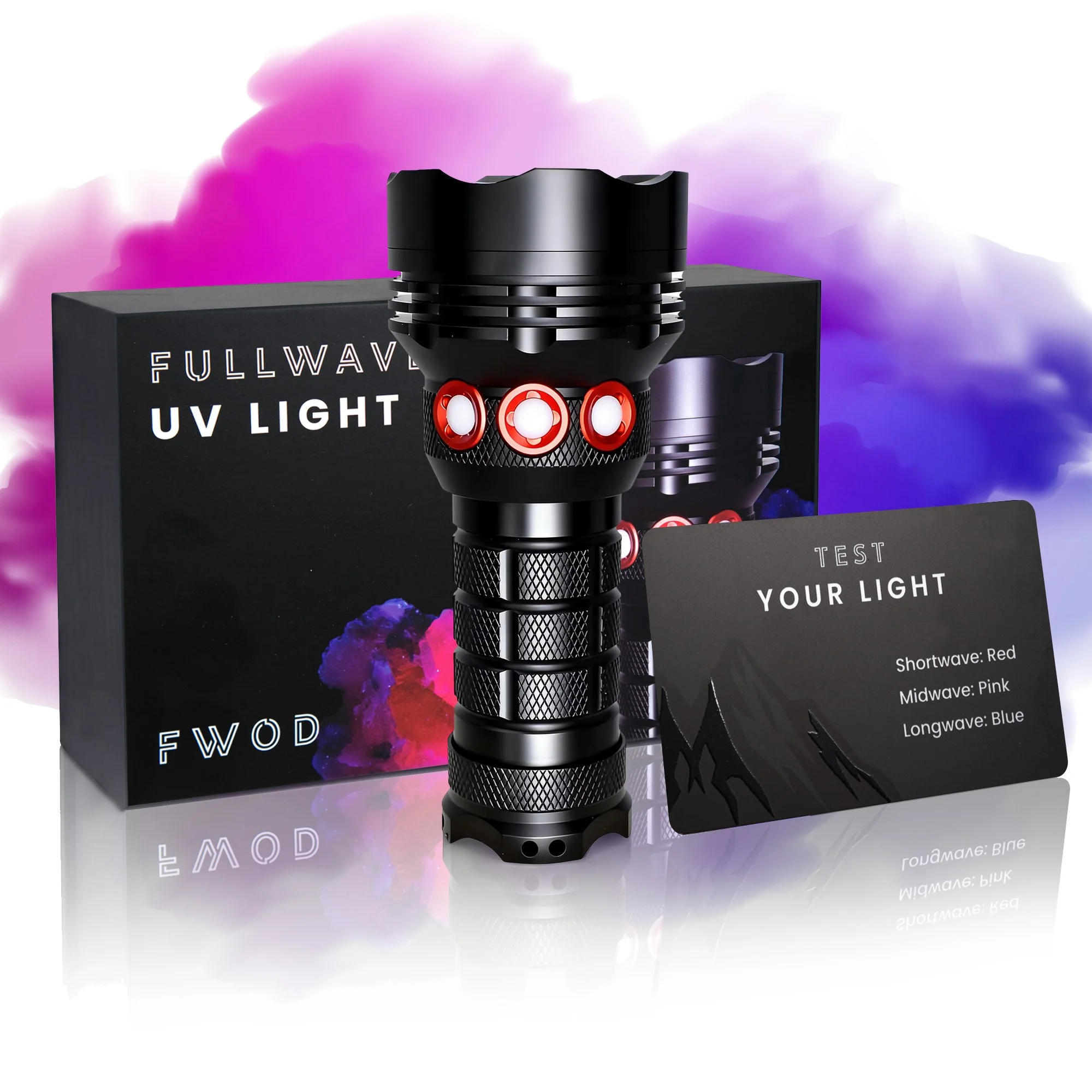
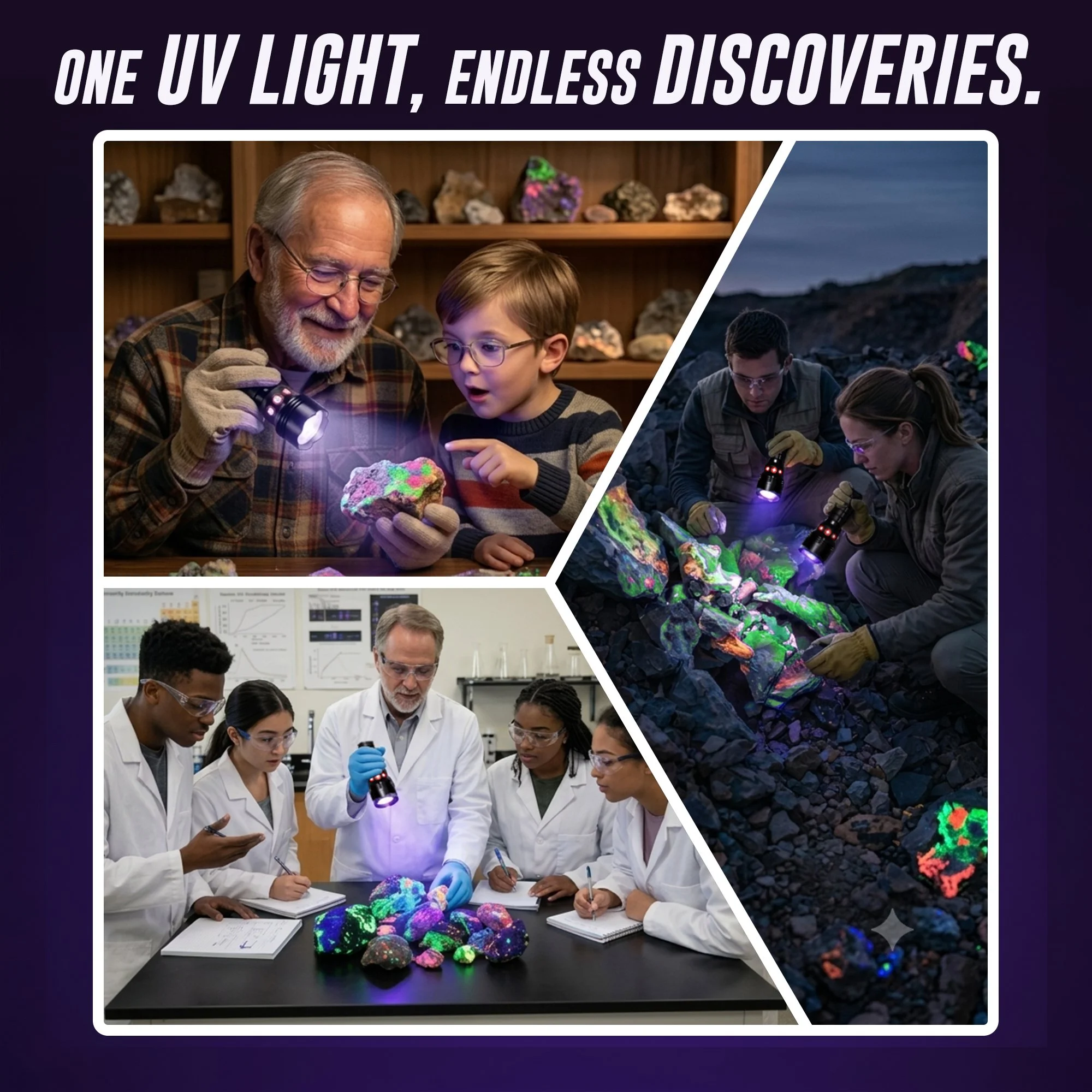
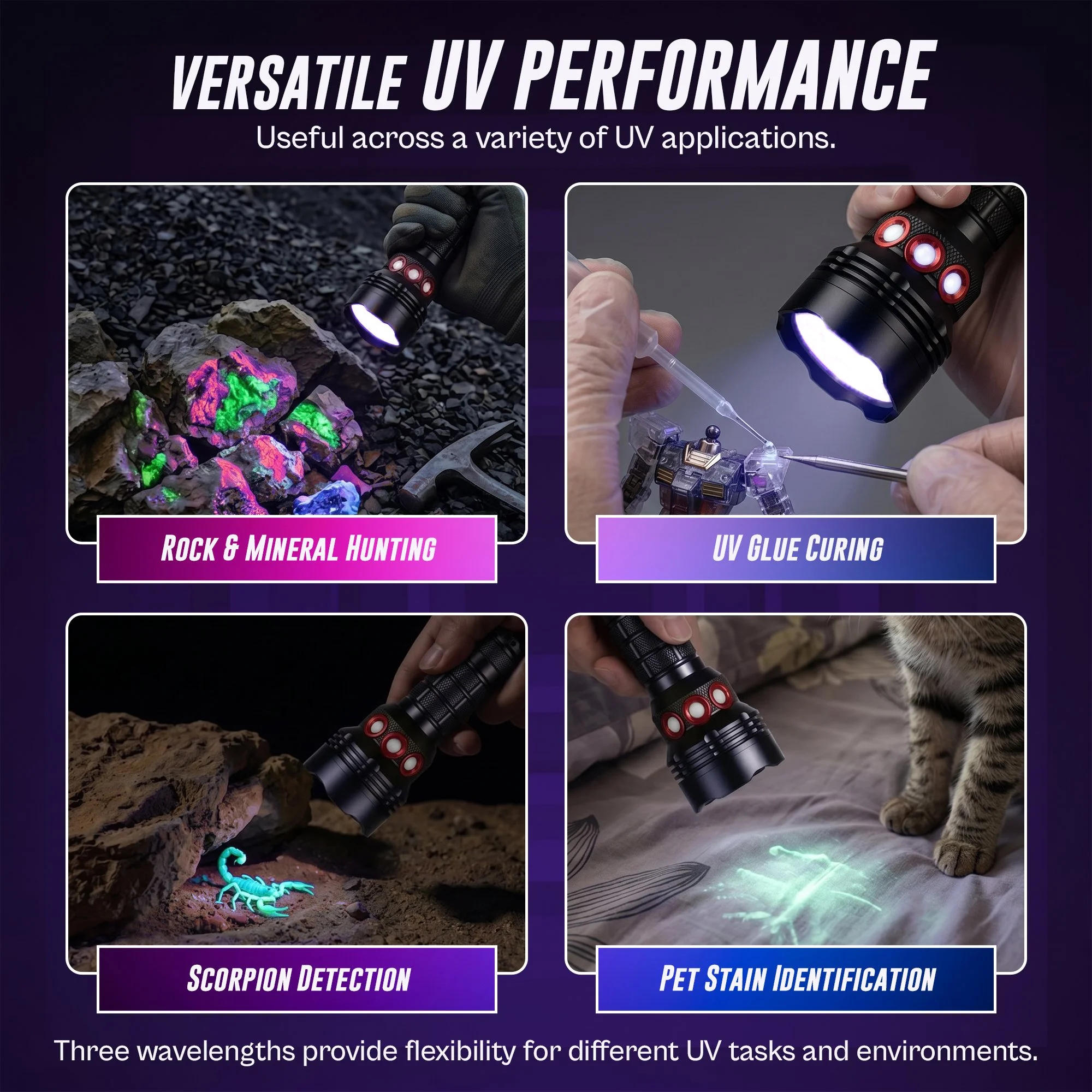
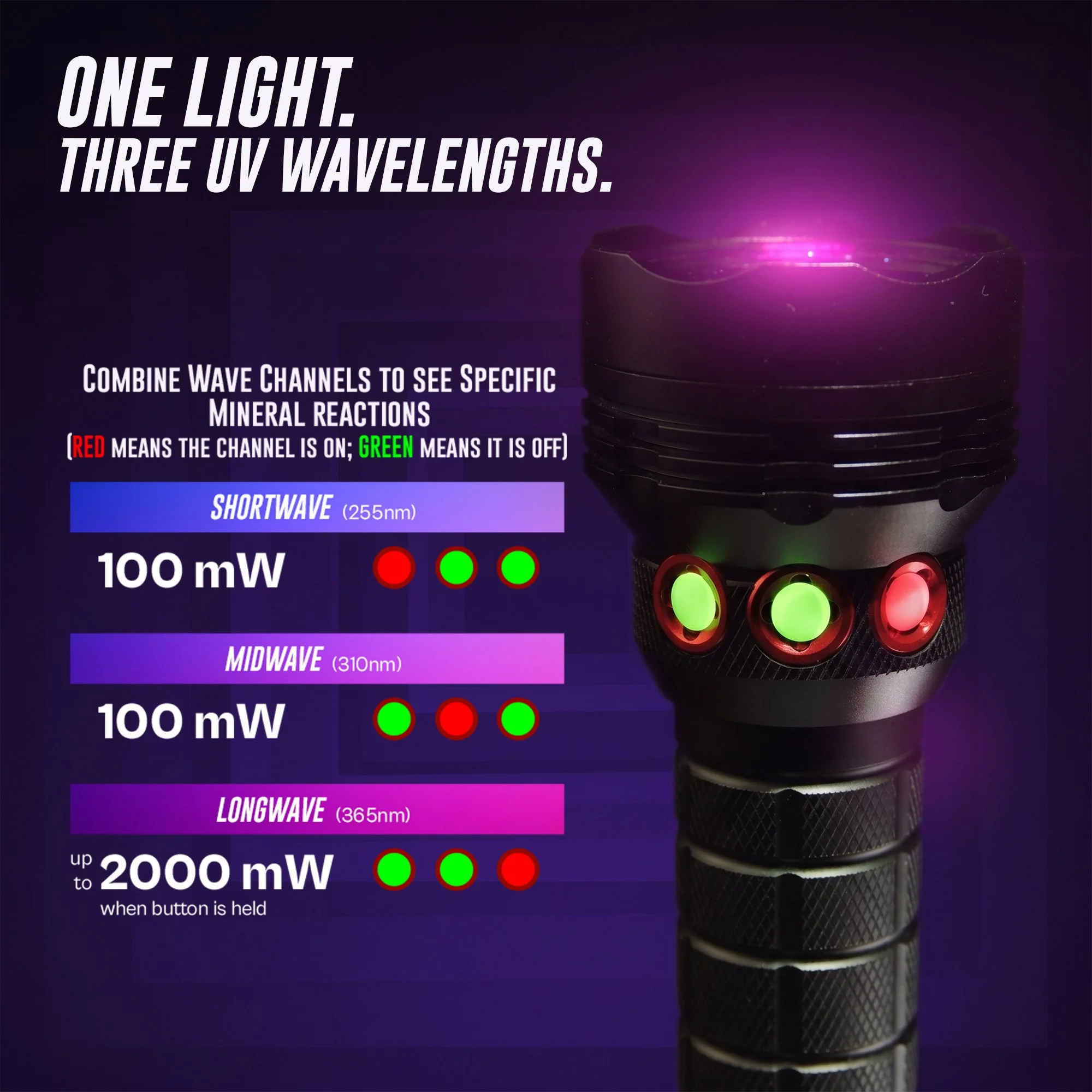

Shortwave, midwave and longwave
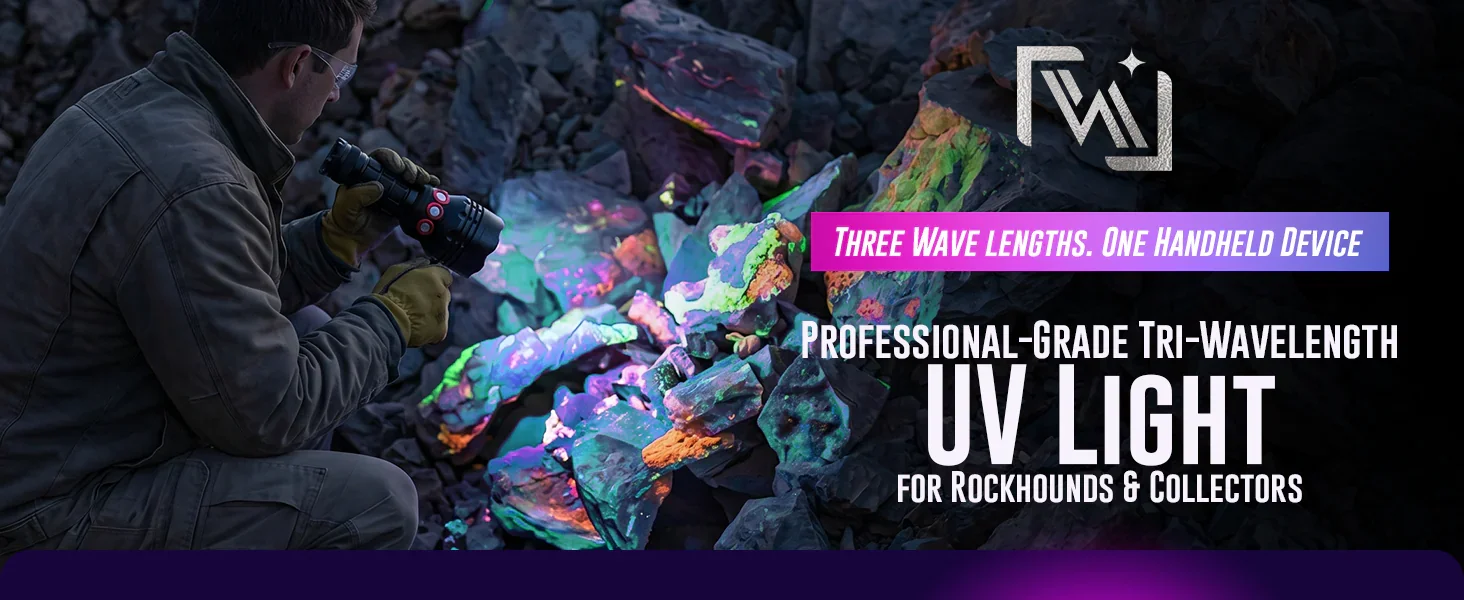
Fluorescent minerals do not all answer to the same ultraviolet light, and which band you carry decides what you can find. Longwave at 365 nm — yooperlite, sodalite, scapolite, hackmanite — is what almost every UV flashlight is, and a good 365 nm light will serve you for years; nothing here replaces it. Midwave at 310 nm is the band almost no handheld light has, and some calcites and apatites answer here and nowhere else. Shortwave at 254 nm is where willemite, scheelite and hardystonite live — much of what makes a display case worth looking at simply does not respond at 365 nm.
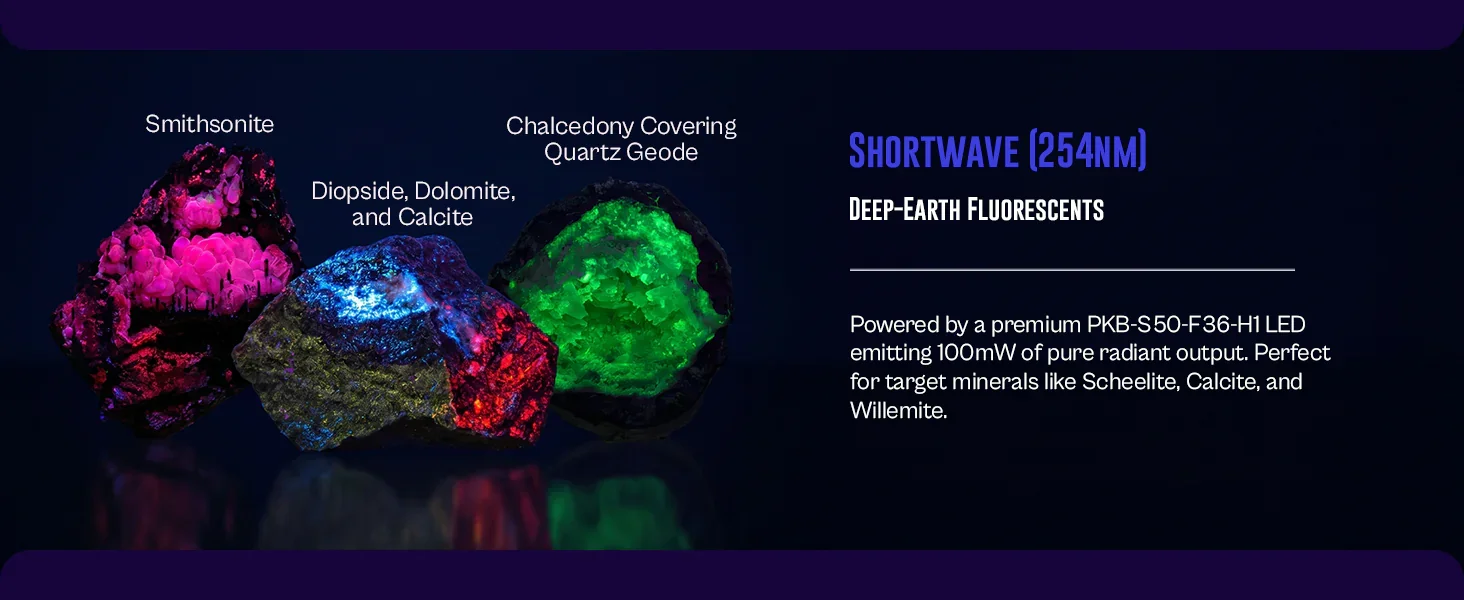
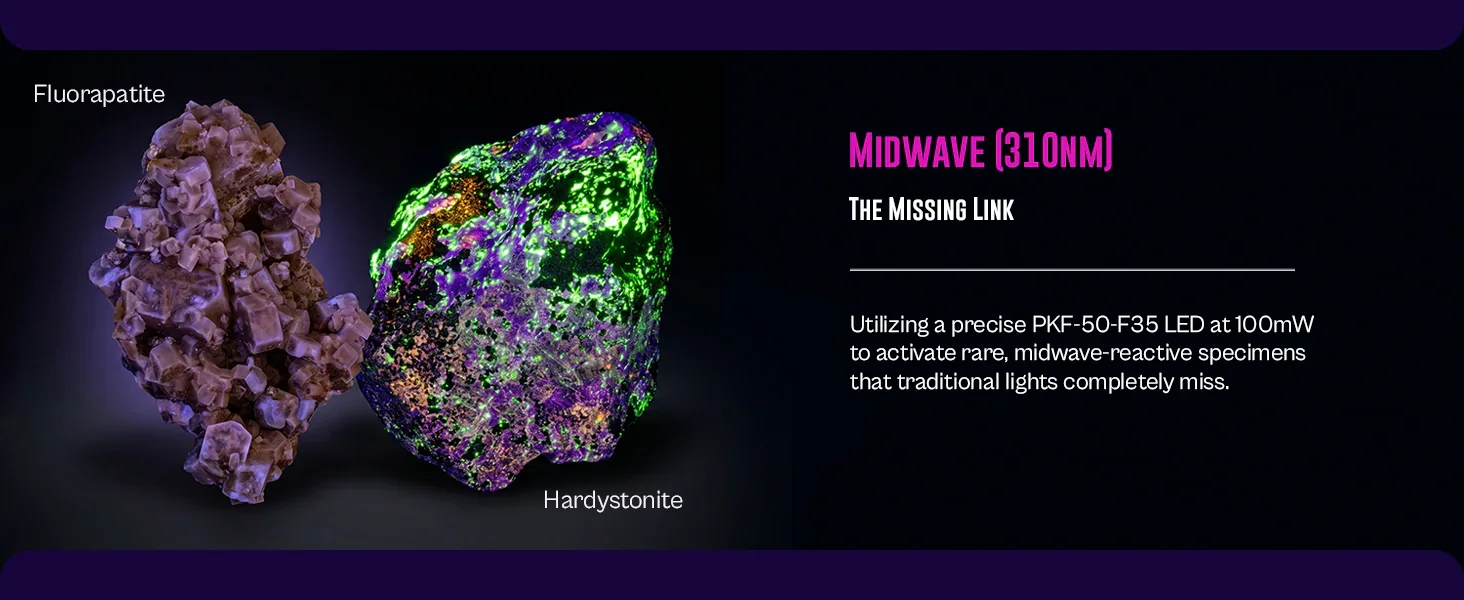
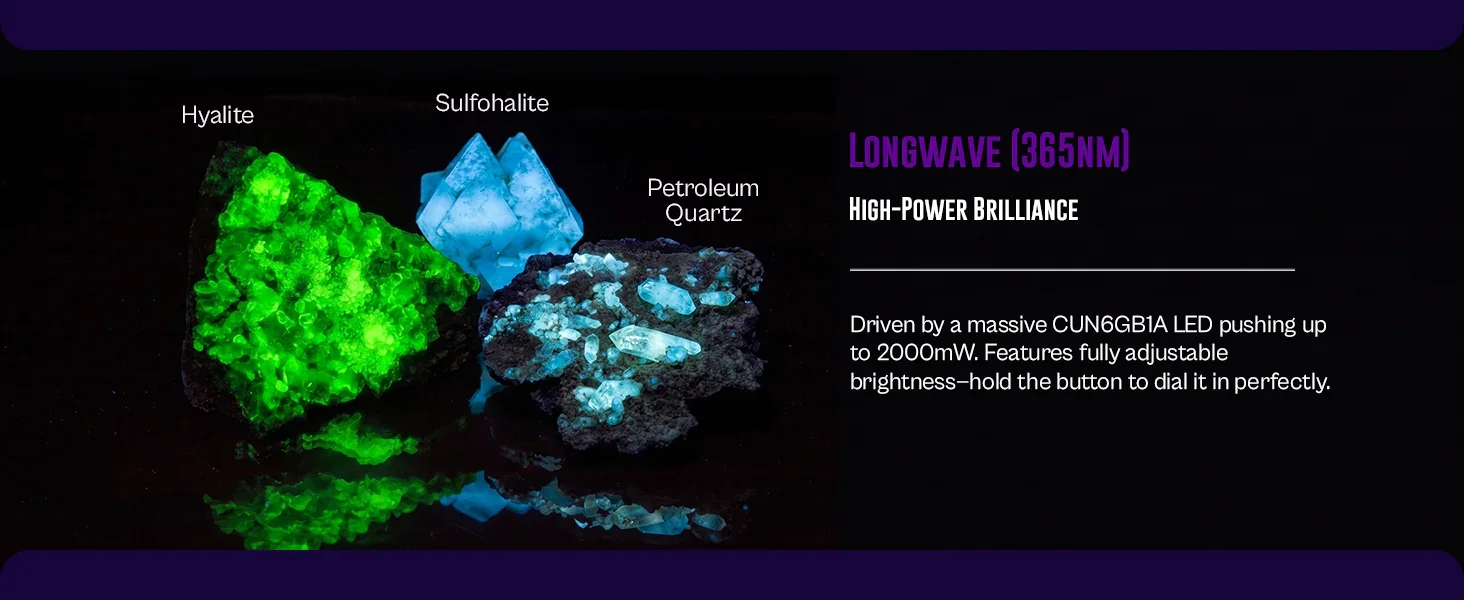
Swipe or scroll sideways: shortwave · midwave · longwave →
What you get for $375
A rock you already own, looking like a different rock.
If you have Franklin, New Jersey calcite-willemite, you have probably seen it give up a dull red under longwave and wondered what everyone else is seeing. Under shortwave the calcite and the willemite separate and fluoresce different colours at once. Same specimen, same shelf — a response your longwave light cannot produce at any brightness, because the mineral is not answering that band.
That is what the money is for. Longwave emitters are a commodity; shortwave is not, and neither is a filter that passes 254 nm while blocking the visible light that would wash the effect out. Those two parts are where the cost of this light sits — not in it being a brighter version of what you already own.
Who this is for
Fluorescent mineral collectors and rockhounds who already have longwave covered and want the bands they are missing — particularly anyone holding Franklin material, or specimens that other collectors keep photographing in colours you have never managed to see. It also suits gem and mineral show attendees and field geologists.
If you only collect longwave-responsive material and are happy, you do not need this light. Buy it when you want the other two bands.
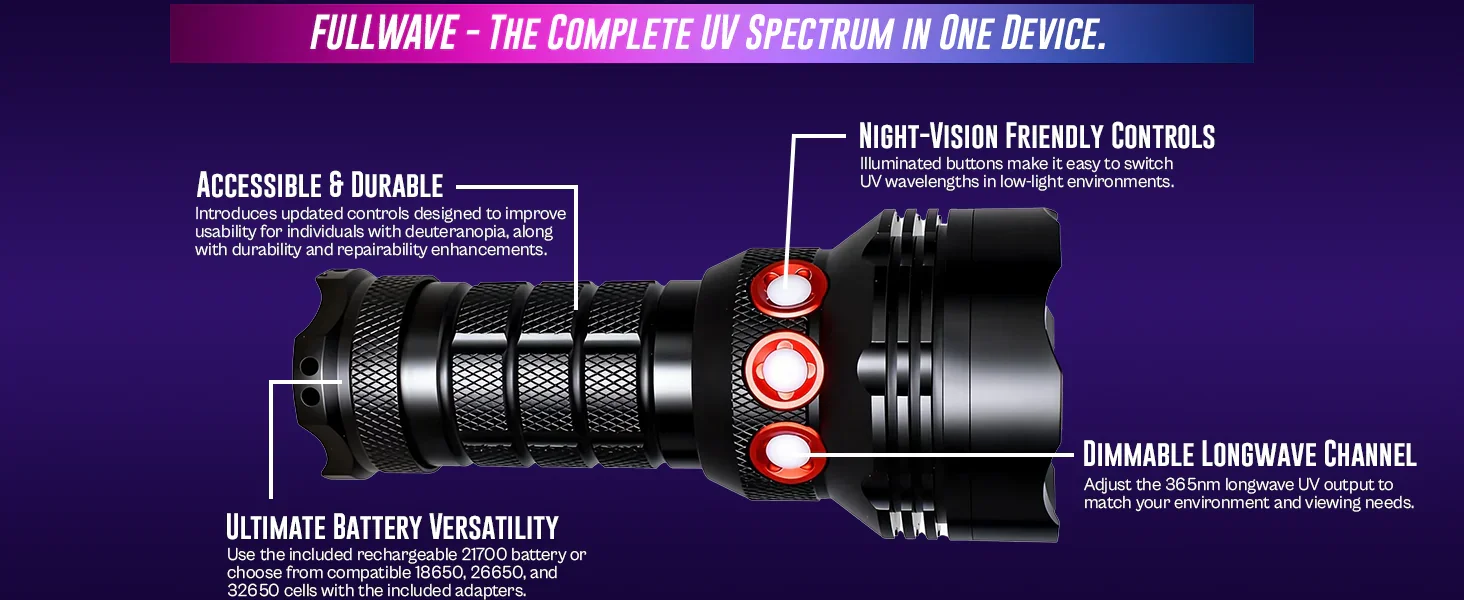
What changed in V2
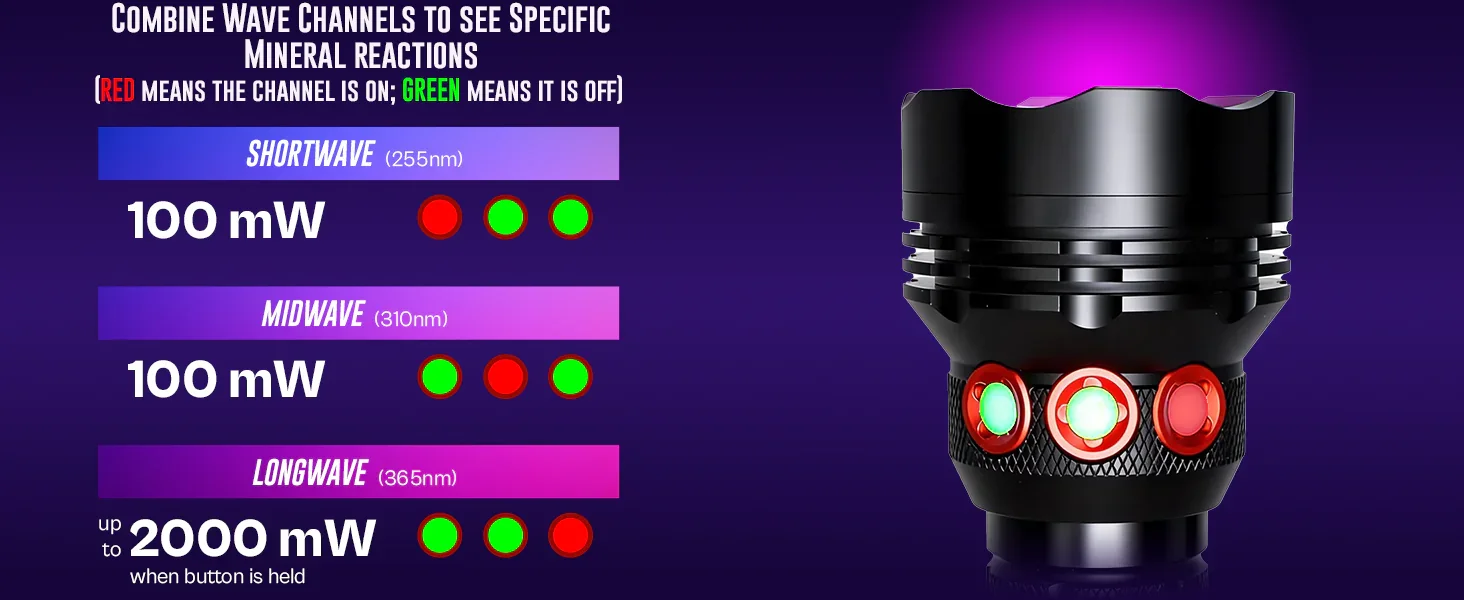
V2 adds a hidden colorblind mode for deuteranopia, so the indicator colours still tell you which wavelength is on if you cannot separate red from green. Square-cut threads improve durability, and a grooved seat for the button board makes the light easier to open and repair.
The dichroic difference
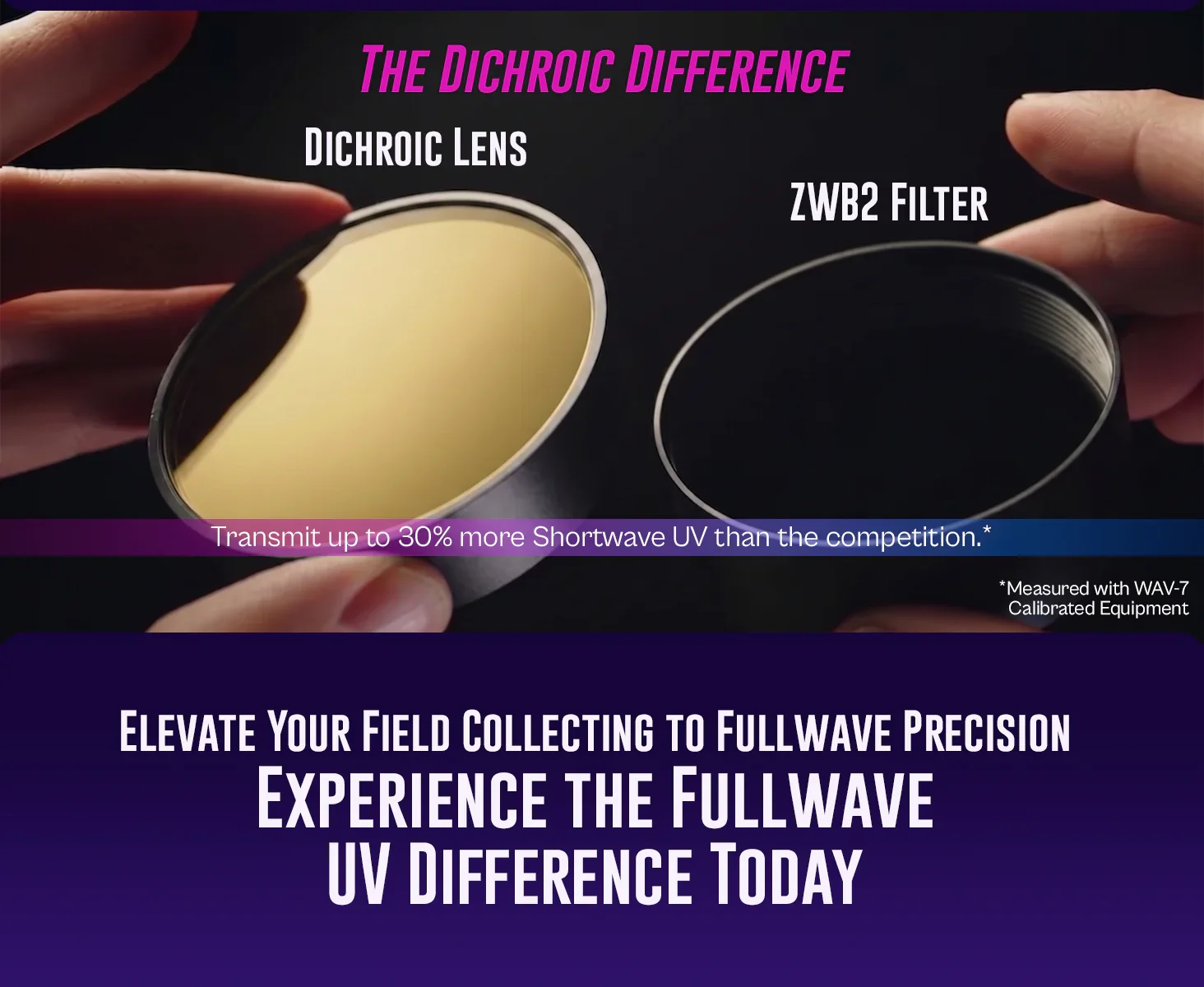
The filter over the shortwave emitter decides how much 254 nm light actually reaches your specimen. Ordinary UV filter glass works by absorption — it soaks up the light you do not want, and some of the light you do. The filter here adds an interference coating that reflects unwanted light instead of absorbing it, so more of the shortwave output survives the trip to the rock.
A standard 2 mm ZWB3 filter is specified by its manufacturer at a minimum of 50% transmission at 254 nm. The coated filter in this light measures 81.5% at 255 nm on a Cary 300 spectrophotometer.
Size, weight and what's in the box
- Head diameter 2.56" (65 mm) · body diameter 1.5" (38 mm) · length 5.71" (145 mm)
- Weight 16.40 oz (465 g) with the battery in, 12.80 oz (363 g) without
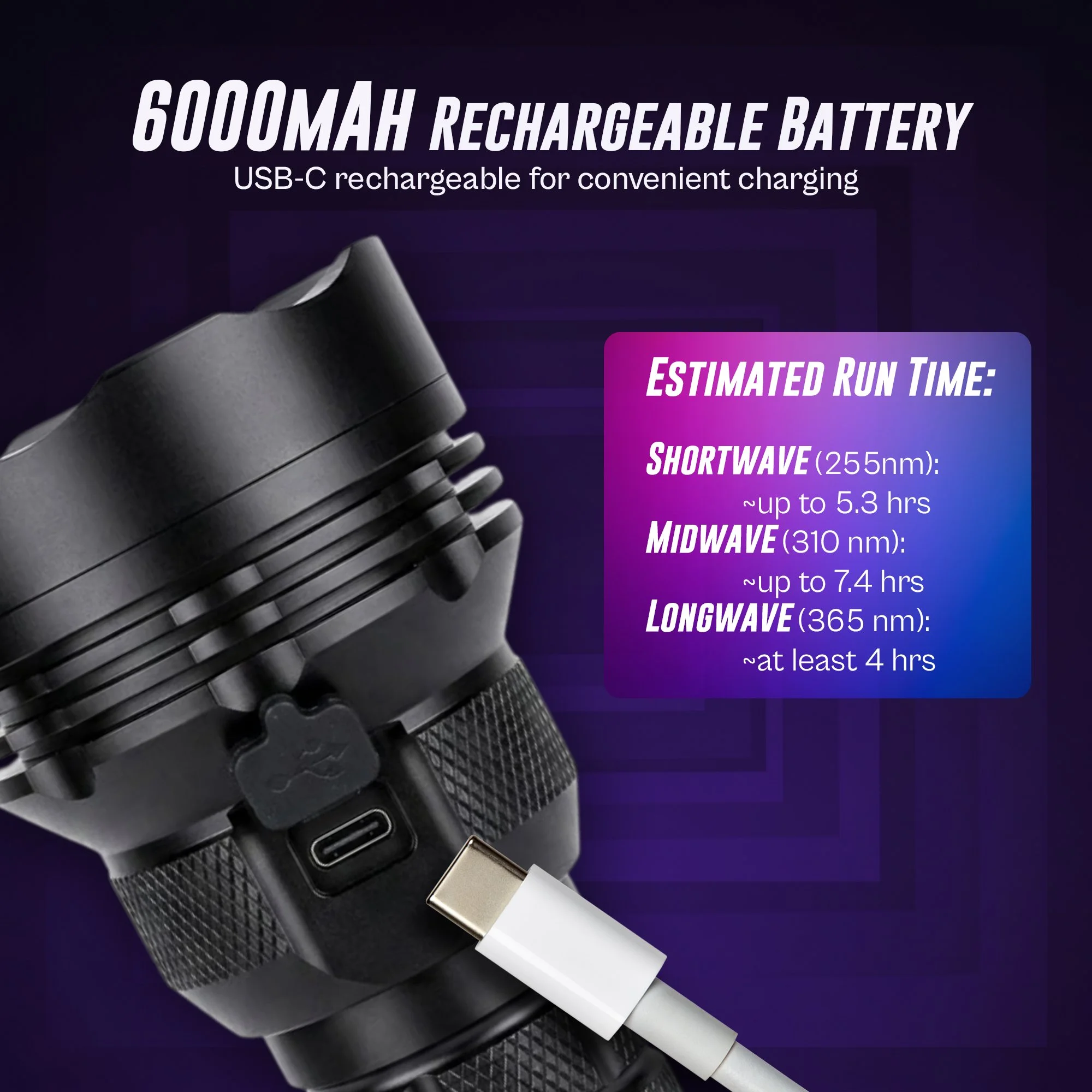
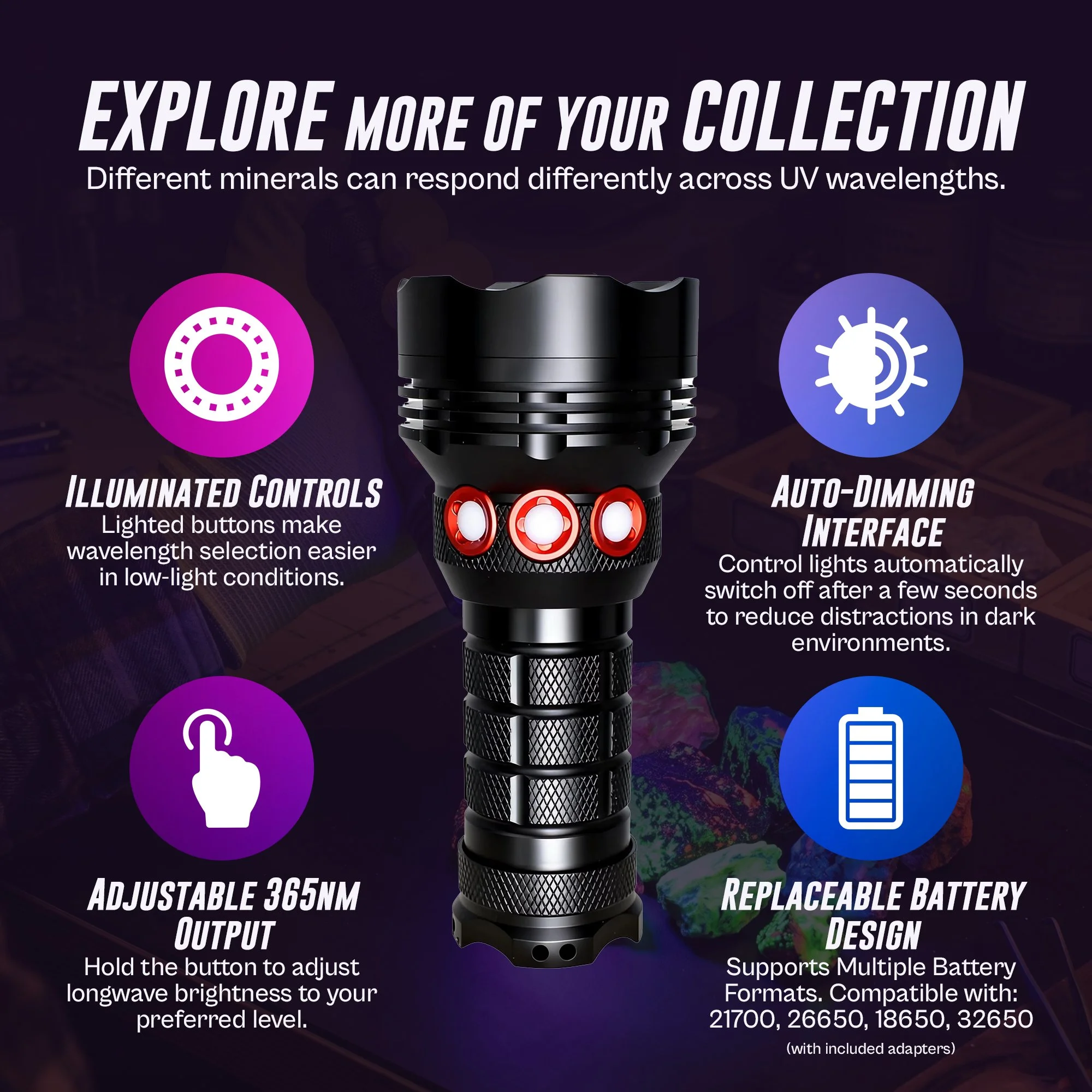
In the box: the light, a 6000 mAh 21700 cell, a USB cable, and adapters so you can run 32650, 26650 or 18650 cells you already own. UV-blocking eyewear is not included — see safety below.
How much light actually reaches the rock
Radiant output tells you what the emitter produces. What matters at the specimen is irradiance — how much of it lands on the surface, which falls off with distance. Measured on this light:
The emitters: shortwave PKB-S50-F36-H1 (100 mW), midwave PKF-50-F35 (100 mW), longwave CUN6GB1A (up to 2000 mW).
| Wavelength | At 4″ (10 cm) | At 15″ (38 cm) |
|---|---|---|
| Shortwave (255 nm) | 10.1 mW/cm² | 2.1 mW/cm² |
| Midwave (310 nm) | 11.3 mW/cm² | 2.6 mW/cm² |
| Longwave (365 nm) | 200 mW/cm² | 50 mW/cm² |
Longwave is the band you sweep ground and walls with at a distance. Shortwave and midwave are bands you bring to a specimen — a hand's width away is the working range, and that is where the numbers above are strongest.
Safety, batteries, warranty and returns
Shortwave ultraviolet is a real hazard, and it is worth being plain about it. The 254 nm channel emits UVC. Do not look into the beam, do not point it at anyone, and do not let it fall on bare skin for long. Wear UV-blocking eyewear rated to block down to 254 nm when you are working close to a specimen, and keep sessions short. Eyewear is not supplied with the light.
- Do not use LiFePO4 3.2 V 32650 cells in this light.
- 1 year warranty against defects. 30 day no questions asked return policy.
- Free worldwide shipping, dispatched in 1–3 days.
What reviewers say
Video: Review of the Fullwave UV Light from Flashlight Reviewer Luxwad
“Makes it easy to hunt and identify specific minerals”
“An impressive and well thought out device”
“Intuitive and easy to use”
LuxWad
Video: Review of the Fullwave UV Light from rockhound content YouTuber Currently Rockhounding
“Pushing the envelope of what you can do with a handheld UV light”
“The longwave ramping is a cool feature to have … You can just dial it in to exactly what you want”
Currently Rockhounding
“Awesome light. Very limited audience but nonetheless well done.” — zoulas, BudgetLightForum
“Nifty light. Wish I had one 40 years ago during my rock hunting phase.” — jeff51, BudgetLightForum
Common questions
-
Many common fluorescent minerals respond to one or more of the wavelengths produced by this flashlight. Examples include willemite, scheelite, calcite, fluorite, sodalite, yooperlite, hackmanite, scapolite and apatite. Which band a specimen answers to varies, which is why covering shortwave, midwave and longwave matters.
-
Shortwave and midwave ultraviolet light can be harmful to eyes and skin with direct exposure. Always wear proper UV-blocking safety glasses, never look directly into the beam, do not point it at people or pets, and avoid prolonged exposure of bare skin. Keep sessions short and keep the beam on the rock.
-
Yes for the longwave and midwave bands. The shortwave band needs care: 254 nm is UVC, it can harm eyes and skin, and eyewear is not included. If you are new to shortwave, buy eyewear at the same time, work in short sessions, and keep the beam pointed at the specimen.
-
No. UV-blocking eyewear is not supplied with the light and you should budget for it separately. The 254 nm shortwave channel emits UVC, which is a genuine hazard to eyes and skin, so buy eyewear that states protection at 254 nm rather than a general-purpose label, and wear it whenever you are working close to a specimen.
-
They are the same unit and directly comparable, so yes, that is a twenty-fold difference in radiant power. Two things make it the right design. First, the bands do different jobs: longwave is what you sweep ground and walls with from a distance, while shortwave is a band you bring within a hand’s width of a specimen, where it delivers 10.1 mW/cm2 at 4 inches. Second, shortwave emitters and the filter they require are a far harder and more expensive technology than longwave, which is why most UV flashlights do not offer the band at all.
-
Probably not, and it is not sold as one. The 365 nm channel is fully variable up to 2000 mW, which is a lot of longwave, but if you already own a good dedicated longwave light you should compare its published output against the figures on this page. We have not measured other manufacturers’ lights and will not claim a comparison we cannot support. Buy this for the shortwave and midwave bands you do not currently have.
-
Both refer to the same shortwave band. The light-emitting diodes are binned at 255 nm. Older shortwave lamps are labelled 254 nm after the mercury emission line at 253.7 nm, so you will see both numbers used for lights like this one. Same band, different measuring convention. This light is specified at its LED bin.